
In Vaastu Shastra, the Panchmahabhootas are the absolute foundation of “living in harmony with nature.” Each element is assigned a specific “zone” in a house or plot. When an element is in its correct direction, the house attracts “Prana” (positive life force); if misplaced, it creates “Doshas” (imbalances).
When people think of Vastu compliant interior design for modern homes, the mind often leaps to rigid rules: sofas pushed tight against walls, mirrors banished from bedrooms, or heavy wooden altars dominating a minimalist living room. Traditional Vastu can sometimes feel like a constraint for the modern homeowner who values bold expression, maximalism, and unconventional aesthetics. However, at its core, Vastu Shastra is not a arbitrary set of superstition-based rules. It is an ancient architectural science rooted in bio-geometry, environmental psychology, and the fundamental physics of space.
The Vaastu Map of Elements : The placement of rooms in a Vaastu-compliant home follows the natural movement of solar energy and magnetic fields.
| Element | Sanskrit | Vaastu Direction | Significance in Home |
| Water | Jal | Northeast | Spiritual growth, clarity, and wealth. |
| Fire | Agni | Southeast | Health, energy, digestion, and cash flow. |
| Air | Vayu | Northwest | Relationships, communication, and movement. |
| Earth | Prithvi | Southwest | Stability, strength, and grounding. |
| Space | Akasha | Center (Brahmasthan) | Expansion, peace, and internal strength. |
When translated into modern, quirky, and expressive interiors, these five elements stop being constraints and become a dynamic creative palette. To achieve energetic harmony, you don’t have to give up your love for velvet emerald couches, industrial exposed brick, or moody, statement-making color schemes. You can design a home that is both visually stimulating and deeply grounding if you know how the Panchmahabhootas interact with your living space
1. Why the Five Elements Matter in Modern Life: The Energy Blueprint Our homes are not just boxes in which we store our belongings; rather, they are living ecosystems. Modern architectural psychology acknowledges that our surroundings directly impact our nervous system, circadian rhythms, and emotional well-being. Vastu approaches this through elemental equilibrium.When your home lacks a specific element or has an over-accumulation of another, you feel it subconsciously. A living room choked by heavy, stagnant air and lack of natural light feels suffocating. A bedroom flooded with chaotic, hyper-stimulating red lighting disrupts sleep.Working with a qualified Vastu consultant early in your renovation journey allows you to map out these energetic zones without compromising your design signature. Treating your rooms as canvasses for sensory storytelling means combining the Panchmahabhootas with quirky interior design, regardless of whether you live in a sprawling penthouse or a high-rise apartment
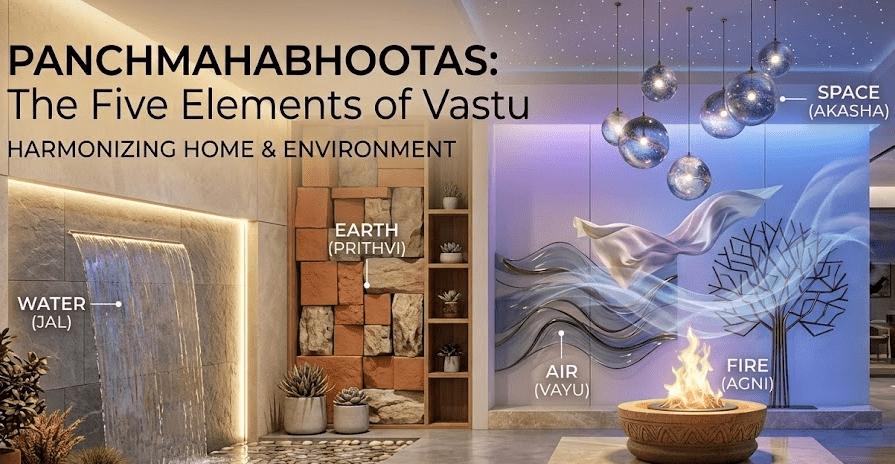
- Earth- The first and foremost element of nature that exerts maximum energy. It is important to consult the land you are purchasing, as the soil, area, and everything matter in Vastu. The selection of site is considered very important in Vastu element. A detailed inspection of soil, plot, site, shape and size has to be done before commencing the construction. Earth (prithvi) is the most important element in Vastu and influence human lives in every way.
- Water-Water (jal) is present on earth in the form of rain, ocean, sea and rivers. It is the second most important element considered in Vastu. Vastu provides proper directions for the placement of water sources. Water is an element of the north-east. As far as the flow of domestic water is concerned, it should be drained out of the north-east only. The water bodies, such as swimming pools and aquariums, etc, need to be made in the north-east, this direction is auspicious and suitable for water.
- Fire-Fire (Agni) is considered as an element of south-east. In a house kitchen fire or electrical gadgets shall be place in south-east. Light is the essence of life, and sun is the natural light giver. Fire is the basis of all sources of energy including thermal power and atomic power. There should be proper ventilation for sunlight being necessary and natural source of light for human beings.
- Air-Air (vayu) is a necessary thing for all of us living on this earth. In Vastu air is another important element which is considered before applying it. Air is an element of north-east. Air consists of various gases on earth like oxygen, nitrogen, helium, carbon dioxide etc. A balanced percentage of different gases, atmospheric pressure and humidity level are important for living beings on this earth. There are important directions for windows and doors in Vastu so as to receive a good amount of air.
- Space-Sky is never ending and our space is full of constellations, galaxies, star, moon, sun and all the nine planets. It is also called universe which is known as ‘Brahamand’- the place of god. Space has a very important place in our lives and Vastu gives different directions for better space. Indian houses used to have open space in the centre of the house. Akash is a brahmasthan which should be an open place, any disturbance related to space in house would lead to detrimental results.
In the practice of Vaastu Shastra, the Panchmahabhutas are not merely symbolic; they are the literal forces that dictate the flow of energy within a structure. By aligning a building with these five elements, we transform a physical space into a living ecosystem that supports human potential.
The Essence of Elemental Balance
The ultimate goal of Vaastu is to create a spatial equilibrium where the five elements coexist without conflict:
- Stability and Growth: By honoring the Earth (Southwest) and Water (Northeast) axis, a home gains the foundation needed for financial stability and the clarity required for spiritual and intellectual growth.
- Vitality and Flow: By properly positioning Fire (Southeast) and Air (Northwest), the inhabitants ensure that their physical energy is high and their social/professional connections remain fluid and productive.
- Connectivity: By keeping the Space (Center) open and light, the entire structure is allowed to “breathe,” ensuring that positive Prana can circulate to every corner.
Synthesizing the Five Elements in Your Floor Plan Balancing the Panchmahabhootas doesn’t mean treating your home like a strict laboratory. It means curating a harmonious gradient of energies across your layout: Element Primary Zone Quirky Design Manifestation Akash (Space), Center (Brahmasthan) Double-height voids, minimalist furniture footprints, expansive bare walls.Vayu (Air)North-WestKinetic mobiles, sheer floating linens, optimized cross-ventilation layouts.Agni (Fire)South-East Suspended bio-ethanol fireplaces, neon art, layered ambient warm lighting.Jal (Water)North / North-East Epoxy resin water-effect floors, rippled glass partitions, indoor slate water features.Prithvi (Earth)South-WestTravertine stone tables, lime-washed plaster walls, large terracotta urns.Collaborating with an experienced Vastu consultant ensures that these elemental zones are respected structurally, while your personal interior designer weaves in the eclectic, quirky textures that make your house uniquely yours.
Final Takeaway
Vaastu Shastra teaches us that we are deeply influenced by our surroundings. When the Panchmahabhutas are in their rightful places, the home acts as a magnet for health, wealth, and harmony. To live in a Vaastu-compliant space is to live in a state of conscious architecture, where the boundaries between the individual, the home, and the universe dissolve into a single, synchronized rhythm. Crafting Your Elemental Sanctuary Your home should be an extension of your spirit—unapologetically expressive, layered with personality, and fundamentally balanced. You can bridge the gap between timeless spatial science and cutting-edge modern aesthetics by treating the Panchmahabhootas as a rich sensory toolkit instead of rigid ancient restrictions. Embrace the open void of Akash, let Vayu sweep through your open spaces, ignite your rooms with the passion of Agni, flow with the intuition of Jal, and remain firmly rooted in the comforting embrace of Prithvi.
2 Comments
Great content! Keep up the good work!
Thank you and stay connected for more blogs.